
About Glass

Four Styles, Four Types, Fifty Years of Looking Closely

The thousands of windows we’ve placed since 1974 span roughly 1850 to 1940 — a period when American design moved through four overlapping styles: Victorian, Arts & Crafts, Art Nouveau, and Art Deco. Historians don’t always agree on exact dates, and plenty of real windows straddle two styles at once. That overlap is part of what makes this glass interesting.

We organize everything we sell by style first, then by glass type — stained, beveled, combination, or specialty — so you can browse however makes sense to you. Below is a quick orientation to both systems, plus a short glossary of terms you’ll see throughout the site.

Buy what you like. Chances are, you will never be sorry.

1850–1940 Period Covered 4 Design Eras 4 Glass Types 8,000+ Windows Placed Since 1974
Glass Styles

Four eras define most of what we sell — plus a fifth category for windows that fall between them. Each links to a full page of history, characteristics, and examples.

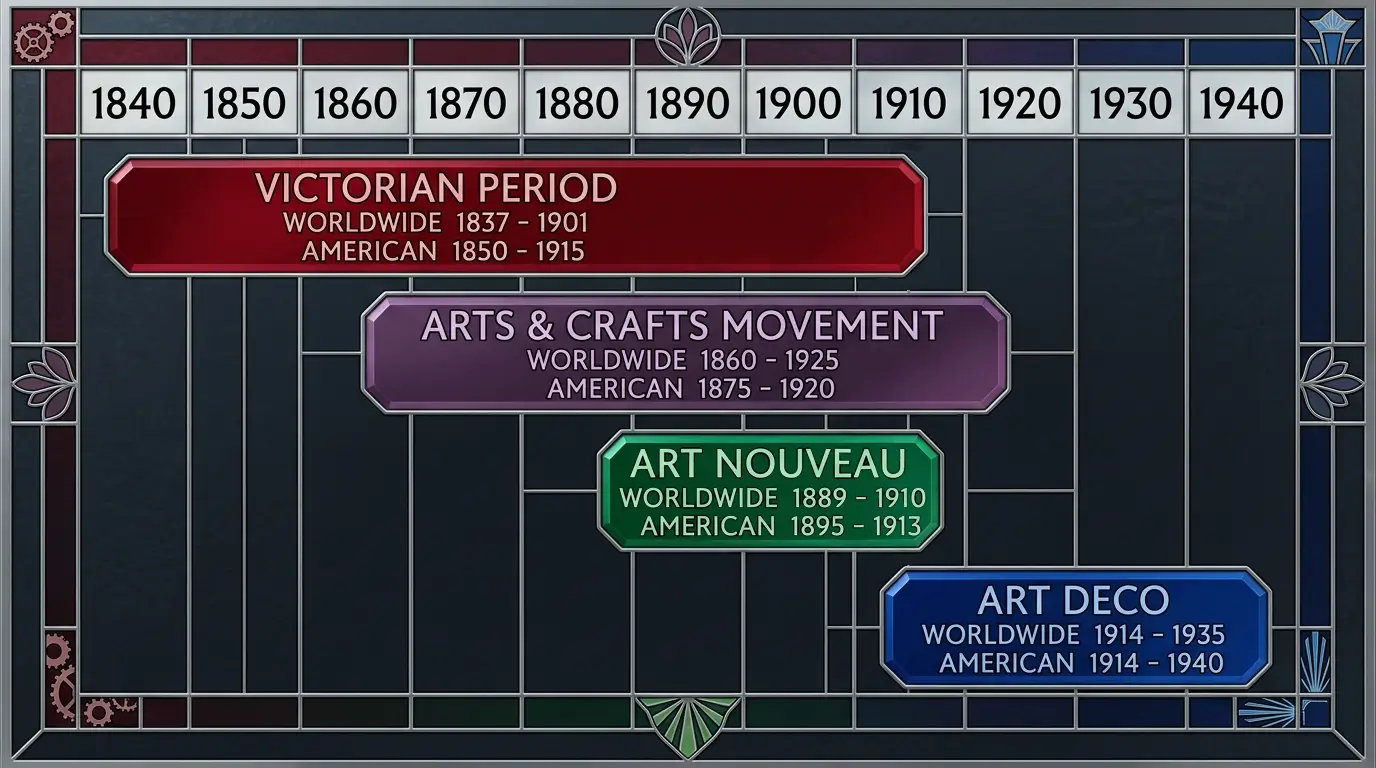
Timeline comparing the Victorian, Arts and Crafts, Art Nouveau, and Art Deco periods worldwide and in America from 1840 to 1940

Worldwide 1837–1901
American 1850–1915

Victorian

A grand mash-up, not a single look. Under one queen’s 64-year reign, American architects blended Gothic Revival, Queen Anne, Eastlake, and half a dozen other styles into homes as ornate and eclectic as the era’s optimism.

Worldwide 1860–1925
American 1875–1920

Arts & Crafts

A reaction against the machine age. Inspired by William Morris and Gustav Stickley, this style favored honest lines and natural materials — the aesthetic behind Prairie-style homes and Craftsman bungalows.

Worldwide 1889–1910
American 1895–1913

Art Nouveau

Short-lived and unmistakable. Sinuous, organic lines — vines, florals, flowing hair — replaced centuries of classical convention. Tiffany and La Farge were among its great American practitioners.

Worldwide 1914–1935
American 1914–1940

Art Deco

Named for a 1925 Paris exhibition, but built for the machine age. Geometric and symmetrical — think sunbursts and lightning bolts — shaped by automobiles, skyscrapers, and Tutankhamun’s tomb.

Any Era

Transitional

Style doesn’t flip overnight. Many windows blend two eras at once — Neo-Classical geometry easing into Art Nouveau curves, say — and recognizing the overlap is often the key to dating a piece.

Glass Types

Within any style era, we also sort windows by how the glass itself was made and assembled. Each links to a full page on materials, technique, and how to spot the real thing.

Stained

True stained glass gets its color from within the glass itself, not paint on the surface. Tiffany and La Farge spent the 1870s–80s inventing new colors and textures — including opalescent glass, an American original.

Beveled

Clear plate glass, ground and polished at an angle to throw prisms of light. We spot real antique bevels by their faint greenish cast, their thickness, and tiny hand-ground “chatter marks” machines can’t replicate.

Combination

Stained glass, beveled glass, and jewels in one window. Once bevels became affordable in the 1880s, designers folded them into stained compositions as sunbursts, urns, and shell motifs — almost always one-of-a-kind.

Specialty

Everything that doesn’t fit the other three: hand-painted panels, silver-stained accents, acid-etched and wheel-cut designs, and the strange, lead-free brilliance of Belcher Mosaic windows.

A Buyer's Glossary

A few terms worth knowing before you shop. The full glossary covers all fourteen.

Antique Glass
Mouth-blown sheet glass of the kind used in medieval church windows — crisp color, irregular light refraction.
Cathedral Glass
Machine-made glass in pale tints with textural effects; early American examples (c. 1860) show primitive irregularities.
Flashed Glass
A base layer of clear or white glass fused with an extremely thin layer of contrasting color, often acid-etched or wheel-cut.
Glue-Chipped Glass
A frost-like surface created by drying hot organic glue on etched glass, pulling small chips away as it cures.
Jeweled Glass
Faceted decorative pieces set into a window's mosaic — in old American windows, often hand-cut and hand-polished.
Muff (Venetian) Glass
A blown bubble of molten glass swung into a cylinder, then flattened into a translucent sheet.
Silver Stain
Silver nitrate fused to glass in a kiln, producing colors from pale yellow to deep orange — the origin of the term "stained glass."
Zipper-Cut Glass
Notch patterns ground along a beveled edge, resembling a zipper and forming their own decorative element.

Ready to See What’s Available?

Browse current inventory by style or type, or get in touch if you’re
hunting for something specific — we’re often able to source pieces we don’t have on hand.

2026 All Rights Reserved | Age of Elegance